

Europe needs to get real on defence; Britain needs to get real on Europe
13 February 2025


Post
2 February 2011

3 minute(s) read
Recent Posts

207. Gordon Brown: How to Fix a Fracturing World
What did Gordon Brown learn from leading the UK through the global financial crisis? Why do so many citizens today not belong to any civic or religious group, and how does that impact our politics? Ho... Continue21 September 2026
Posted by Alastair Campbell
The Greatest Threat Humans Just Can’t Stomach with Yuval Noah Harari
Episode 2 is available right now for TRIP Plus members. Sign up at therestispolitics.com What can the Aztec Empire's catastrophic failure to understand Cortés and the Spanish conquistadors teach us ... Continue18 September 2026
Posted by Alastair Campbell

572. Trump’s Next Middle East Crisis and Reform’s £72m Megadonation
Is the Houthi’s seizure of one of the world's most critical waterways the clearest proof yet that Trump's Iran war has become a catastrophe? With the very people building AI now calling for a pause,... Continue17 September 2026
Posted by Alastair Campbell

16 September 2026
Posted by Alastair Campbell

571. Rory and Alastair Challenge Ed Miliband on Israel-Palestine
Why has Ed Miliband gone further than any previous foreign secretary in confirming the occupation of the Palestinian territories as illegal and placing sanctions on Israeli settlements in the West Ban... Continue15 September 2026
Posted by Alastair Campbell
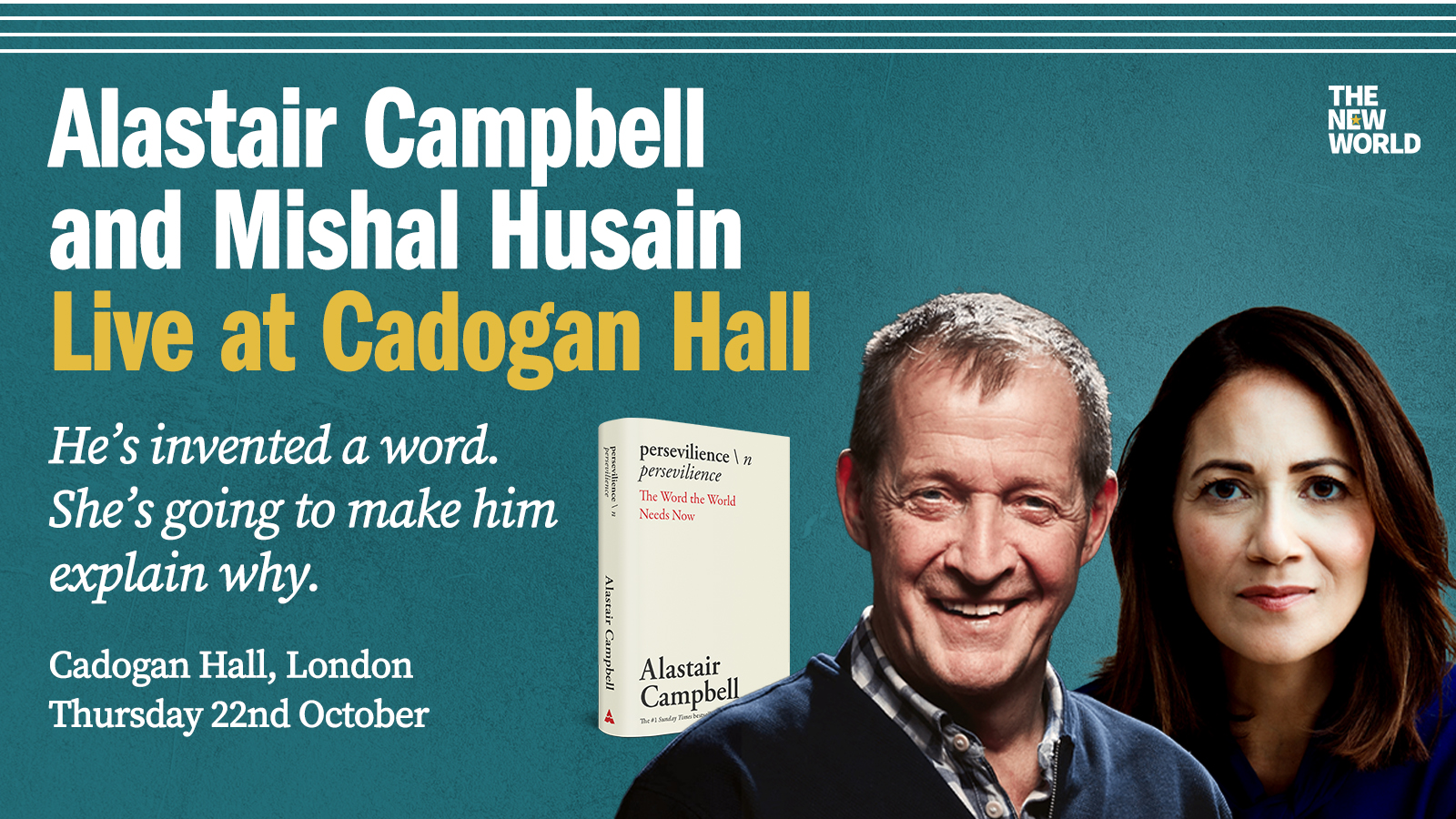
Join Alastair Campbell and Mishal Husain live at Cadogan Hall
Persevilience: The word the world needs now is the title of Alastair Campbell’s new book. It is also the starting point for a conversation with... Continue
14 September 2026
Posted by Alastair Campbell
206. How Putin’s War Changed Finland Forever (Sanna Marin)
Following Putin's war in Ukraine, how politically challenging was it committing Finland to join NATO? What was it like becoming the world's youngest sitting prime minister at 34? Why did a scandal ove... Continue14 September 2026
Posted by Alastair Campbell

“Our Generation Was Lied To”: Two Gen Z MPs on Fixing Politics
To hear the full series “The Gen Z Story”, sign up at the restispolitics.com – use your student email for a discount How do you get older colleagues to take you seriously when you become an MP ... Continue11 September 2026
Posted by Alastair Campbell



I welcome this new initiative- I was listening to BBC Radio Five Live and Nicky Campbell was interviewing Nick Clegg. There seemed to be too much focus on his use of the word ‘Bonkers’ during the recent election campaign. It’s not abou t that
Oh Alistair: You’ve finally succumbed to believing spin. Check out the Mental Health provision cuts up and down the land because of NHS spending freeze. Check out the quality of the “talking therapies” being offered by Clegg.
This is CBT-lite offered by semi trained nurses from OUTSIDE the mental health field. It’s done without consultation with the professionals and the net effect is more damaged people with more problems down the line.
I’m truly suprised that someone who has suffred these difficulties, this illness called depression would back such a thinly disguised con.
I just pray the help get doesnt fall foul of the cuts. My consultants say CBT failed with me and I need TRUE talking thjerapy. No provision for that though!
I hope you are right, but sadly the coalition doesn’t seem to have taken on board a similar message in regards to legal aid. Similarly cutting it is an ‘easy option’ but very short-sighted as there are, as in mental health, knock-on effects for welfare, housing and criminal justice.
I hope you are right, but sadly the coalition doesn’t seem to have taken on board a similar message in regards to legal aid. Similarly cutting it is an ‘easy option’ but very short-sighted as there are, as in mental health, knock-on effects for welfare, housing and criminal justice.
Mmm. giving praise to Clegg at the moment. I reckon he would say yes to anything, and that is right to anyone at the moment.
Why Clegg though? Puzzling. What he claims to know about mental health can be written on the back of a postcard, I would have thought.
Agree. There is, however, another battle still raging and that is around the nature of the psychological therapies on offer. Those who apply a strict medical model seem to opt for a CBT-based service because it is most closely analogous to ‘medicine’ whilst patients and informed therapists recognise the value and effectiveness of a broader range of evidence-based therapies. Mental Illness is as much a psychosocial problem as it is a medical one, and the therapeutic effort needs to go way beyond that being offered in some IAPT services. Some time ago, under the old local commissioning system, I was bidding for enhance therpy services for people witha mental illness but lost out to a GP who was particularly interested in rectal bleeding. It is this sort of competition that will increase if GP Commisioning is not reined in, and it does a disservice to people with mental health needs.
You do a sane and sensible piece then have to spoil it with the inevitable tribal jibe. The Conservative default position is that “cuts to mental health services are an easy option”? Absolute, total rubbish. Lansley has never said or implied that and the Coalition has just found £400m extra to spend in this area.
A good and interesting blog AC. What concerns me (not personally, thankfully) is that a great many people will be losing their jobs under this Tory led gov. and inevitabley many will fall into debt and with that possibly depression. All this at a time when cuts to mental health services will be taking an effect. If seriously clinically depressed people who don’t respond to prescription drugs from their GP’s find there is no other form of help available then there will be many more avoidable tragedies occuring. I guess DC will be hoping The Big Society will be taking up the slack on this
issue, along with care of the elderly, running libraries and everything else.
As you say, AC, credit where credit’s due. But as you add, the actual cutbacks to mental health services do rather undermine Clegg’s fine words.
BTW, do you have a link for the Spectator article? It seems a bit elusive when searching on their site. Ta.
Deep resprct for this thought provoking blog, Al. You saw when in power how mental health was ignored, being the least sexy part of the health service. Nothing has changed. If clegg wants to really leave his mark, as you suggest he has a difficult brief, but we can all lobby him to keep his feet to the fire.
An equally urgent priority is for the benefit system and in particular the fitness for work assessment to stop discriminating against people with mental illness. The last government never tackled this and I was one of many thousands of people wrongly denied benefit despite a chronic mental health incapacity. Incredibly, a DWP official wrote to a tribunal that because I could make a cogent argument I couldn’t be mentally ill. That kind of ignorance is endemic in the system.
Whilst I admire your campaigning on this issue, I wish you could have exerted more influence on Ministers in the last government in regard to mental health issues. Maybe you tried but were ignored.
How different we all are. Some of us, such as me respond well to drug treatment. Though I have to say the old tricyclic drugs were useless for me. But the newer SSRI’s suit me very well indeed. In fact I’ve been on a low maintenence dose for 15 years now and have never felt better.
Other people such as you J D Renegade, seem to fair better with talking therapy. My doctor tried that with me once about 20 years ago, when the tricyclics didn’t work. The problem was the man I saw had such a terrible speech impediment, I just couldn’t take him seriously at all. In fact I had to struggle to keep from laughing, so I suppose it kind of worked for me in that I could never have gone back to see him again. Trying to keep a sense of humour even when at the very bottom of that dark hole can be a real life-saver.
May I wish you well J D R and anyone else who has a similar problem.
Dear Alastair
Your point about access to psychological therapies ‘more routinely within the NHS, including for people with serious mental illnesses’, is an interesting one.
I work in mental health in secondary care and those with ‘serious mental illnesses’ are not eligible for psychological therapies because they are deemed to be already received those therapies through the community mental health teams. However, there is often no professional in place to deliver these therapies, so they lose out.
Of course what he seems to be saying is that if we adopt access to psychological therapies more routinely within the NHS, including for people with serious mental illnesses, more people will get the help they need early, and acute care beds may not be needed so much. Let’s hope so.
Psychogical therapies are still the preserve of those within primary care – who may well be just as needy as those in secondary care. But many people in secondary care with ‘severe and enduring’ mental health diagnoses are missing out.
You’ve highlighted a definate big hole there monsieur, in the treatment of secondary patients, one that I certainly wasn’t aware of. Let’s hope something can and will be done about that.
To anyone suffering from mild to moderate depression I would recommend reading as much as they can on the subject. My favourite books were written by the late Robert Laing (physciatrist). I couldn’t get on with either Fraud or Yeong (not sure how to spell their names even). But most of what they wrote was total bollox imho. Though
many others thought they were the “cats whiskers” on their subject.
And of course the late great Burtrand Russell has so many downright common sense things to say on the subject of life, happiness and idleness, wonderfull stuff that is both easy to read and completely understand.
How mad’s Tony Blair then? Did God really tell him do do it?
In Haringey a mental health day centre and a crisis unit are being closed. How come?
[…] "70,000 going back into work". Then there was the pleasing Alastair Campbell announcement of the repeal of the "symbolic" section 141 of the 1983 Mental Health Act, which allows the removal from office of any MPs sectioned for […]
thank you for your fairness and balance. These matters ae central to my life and I welcome warmly any and all moves towards justice. I am delighted to see humane care glimmering amongst the darkness of cuts inflicted on the most vulnerable due to the consumate ineptitude of the avaricous few.
Where Mr Campbell is the illness? When we all get a grip of this mental health fraud – anyone remember the day pharmaceutical bought the American Psychiatric Association & their chums at NICE [NICE be foolish]. College Psychiatry, UK, were quick advance chemical lobotomies claim the chemical human had arrived yet we are aware of the worries, thirty years too late.
No diseases within psychiatry, no illnesses, display the facts Mr Campbell and perhaps we could end chemical slavery of a no choice service. Force the issue, plenty dead from it and they cannot speak nor write.
When patient says veto, be that patient, now be that nurse of has no choice. Well being, where, where is the greater good when a service run from fear. Masters & Overseers please no more chemical, no more the internal whip, anyone hear my cries and see my tears. Enough this enslavement.
[…] many mental health campaigners, I gave Nick Clegg the benefit of the doubt when he outlined the government’s strategy for ment… in […]